Priority Program Annual Conference
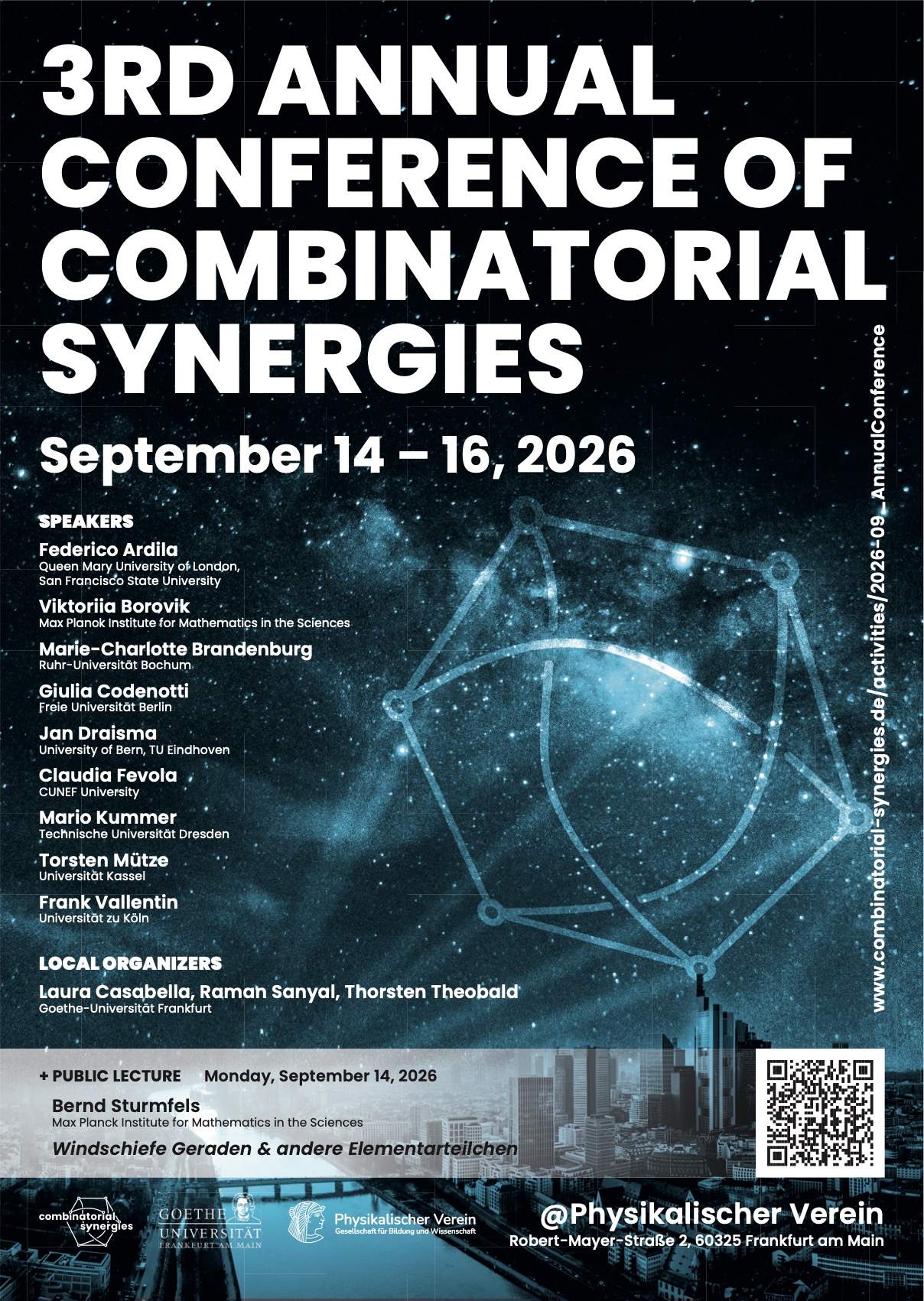
The third Annual Conference of the Priority Program Combinatorial Synergies (SPP2458) takes place in Frankfurt (Main) on September 14-16, 2026. The goal is to bring together members of the SPP working on the different core themes and to foster collaborations.
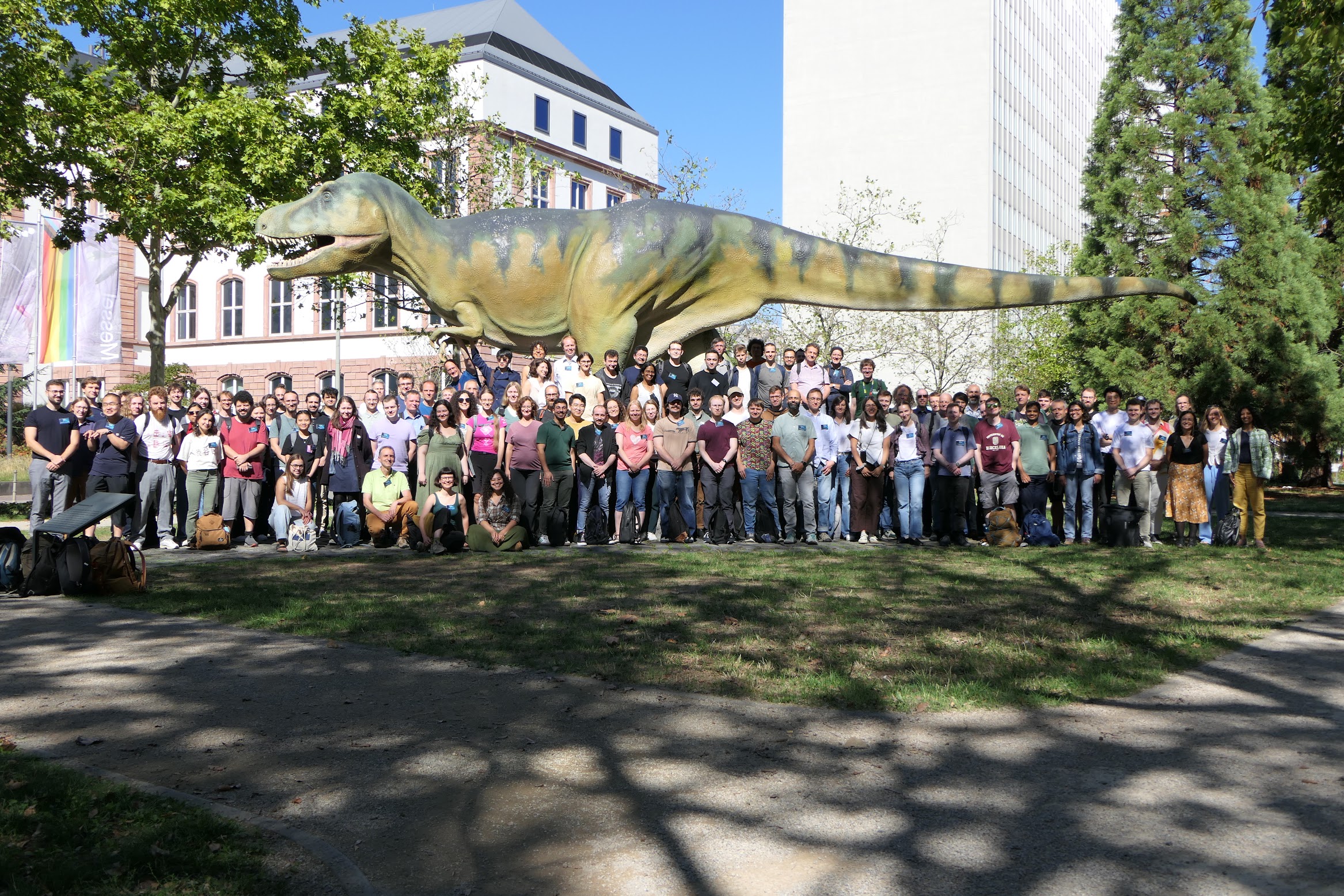
Group photo
Venue
The meeting takes place at Physikalischer Verein, next door to the department of mathematics of Goethe University Frankfurt (Campus Bockenheim).
Speakers
Speakers include:
- Federico Ardila (Queen Mary University of London, San Francisco State University)
- Viktoriia Borovik (Max Planck Institute for Mathematics in the Sciences)
- Marie-Charlotte Brandenburg (Ruhr-Universität Bochum)
- Giulia Codenotti (Freie Universität Berlin)
- Jan Draisma (University of Bern, TU Eindhoven)
- Claudia Fevola (CUNEF University)
- Mario Kummer (Technische Universität Dresden)
- Torsten Mütze (Universität Kassel)
- Frank Vallentin (Universität zu Köln)
On the evening of Monday, September 14 there will be a public lecture by Bernd Sturmfels (Max Planck Institute for Mathematics in the Sciences), titled Windschiefe Geraden und andere Elementarteilchen. See here.
Schedule
| Monday 14 | Tuesday 15 | Wednesday 16 | |
|---|---|---|---|
| 9:00 - 9:30 | Arrival + Registration | ||
| 9:30 - 10:00 | Highlight Combinatorial Synergies |
Borovik | Draisma |
| 10:00 - 10:30 | Ardila | ||
| 10:30 - 11:00 | Break | Break | |
| 11:00 - 11:30 | Break | Highlight Dive into Research |
Brandenburg |
| 11:30 - 12:00 | Fevola | Kummer | |
| 12:00 - 12:30 |
Highlight Young Researchers Conference |
||
| 12:30 - 13:00 | Lunch | Group picture + Lunch | Lunch |
| 13:00 - 13:30 | |||
| 13:30 - 14:00 | |||
| 14:00 - 14:30 | Highlight Artificial Intelligence |
Highlight Activities |
Highlight Synergies’ Finest |
| 14:30 - 15:00 | Mutze | Codenotti | Vallentin (start at 14:15!) |
| 15:00 - 15:30 | |||
| 15:30 - 16:00 | Synergy session | Synergy session | |
| 16:00 - 16:30 | Break + Posters | Break + Posters | |
| 16:30 - 17:00 | |||
| 17:00 - 17:30 |
Panel Combinatorial Inclusivity |
||
| 17:30 - 18:00 | |||
| 18:00 - 18:30 | Rooftop Reception | ||
| 18:30 - 19:00 | Conference Dinner | ||
| 19:00 - 19:30 | |||
| 19:30 - 20:00 |
Public Lecture Bernd Sturmfels |
||
| 20:00 - 20:30 |
Local Organizers
Accommodation
We have blocked some hotel rooms at Aparthotel Adagio Frankfurt City Messe, Hamburger Allee 4. The rooms (both single and double) are 100 EUR per night, with an optional breakfast of 15 EUR per night per person. To reserve a room, please write to using the key word "SPP Jahrestagung".
Food
The conference dinner on Tuesday will take place at Sissi und Franz.
There are many restaurants and cafés within a short walk of the venue. All suggestions feature vegetarian and vegan options.
- Mangetsu — Authentic Japanese izakaya
- NA Sushi & Nudelbar — Vietnamese cuisine, sushi and noodles
- Urban Fusion — Indian and international fusion cuisine
- Heppy — Mediterranean-inspired bowls, pitas, salads and burgers
- Soulmate Coffee & Bar — Café, breakfast, bowls, salads, sandwiches
- Namaste India — Indian cuisine
- Sunbap Bockenheim — Vegan Korean food
- African Queen — Eritrean and Ethiopian cuisine
- Café Crumble — Café with breakfast and light meals
- Die Waffel — Afghan cuisine
- Kish — Persian cuisine
- Isoletta - Italian cuisine
The cheapest option is the Mensa, Cafeteria Bockenheim, whose daily menu can be found here. Another budget option is REWE, a big supermarket featuring a salad bar, bakery and prepackaged meals. All options are pinpointed on the map below.
Towards Leipziger Straße there are many additional cafés, restaurants, bakeries, and takeaway options.
List of participants
See here.
List of accepted posters
See here.
Abstracts
Federico Ardila: Polytopes from amplitudes
Scattering amplitudes and other quantities in physics are given by enormous, intricate sums that are very challenging to compute in practice, and often involve mysterious, extensive cancellations. A powerful technique to explain this phenomenon is to encode the combinatorial complexity of these sums in a geometric object. I will introduce some of the beautiful polytopes that arise and discuss their rich combinatorial structure. Our two central examples will be the associahedron (first discovered in homotopy theory and rediscovered in scattering amplitudes) and the cosmohedron (first discovered in cosmology and finding a homotopy theoretic interpretation).
My talk will discuss joint work with Nima Arkani-Hamed, Carolina Figueiredo, and Francisco Vazão, and will not assume previous knowledge of this topic.
Claudia Fevola: Tropical KP Theory
I will present a connection between the combinatorics of tropical curves and the Kadomtsev–Petviashvili (KP) equation. An abstract tropical curve is a metric graph; its tropical theta divisor is the codimension-one skeleton of a Voronoi decomposition, dual to a Delaunay decomposition. I will describe how to recover, from a strongly connected orientation and a Delaunay polytope, the matroid of a point in a Grassmannian. We call the resulting matroids Delaunaytroids. The talk will focus on graphs, polytopes, and matroids, and no knowledge of integrable systems will be required. This is ongoing joint work with Simonetta Abenda, Türkü Özlüm Çelik, and Yelena Mandelshtam.
Torsten Mütze: Computing Hamilton paths on 0/1-polytopes
In this talk I present a new algorithmic framework for computing a Hamilton path on the skeleton of any 0/1-polytope \({\rm conv}(X)\), where \(X\) is a subset of \(\{0,1\}^n\). The framework uses as a black box any algorithm that solves a variant of the classical linear optimization problem \(\min\{w \cdot x \mid x \in X\}\). The resulting delay, i.e., the time per visited vertex on the Hamilton path, is only by a constant factor larger than the time to solve one instance of the optimization problem. This establishes a connection between optimization and enumeration, namely, if optimization over the polytope is fast, then enumeration (along a Hamilton path) is also fast. When \(X\) encodes a particular class of combinatorial objects, then traversing the skeleton of the polytope \({\rm conv}(X)\) along a Hamilton path corresponds to listing the combinatorial objects by small change operations. We obtain such algorithms for listing a large variety of combinatorial objects such as matchings, independent sets and spanning trees in graphs, or antichains and ideals in posets. The listings are Hamilton paths on the matching polytope, stable set polytope, spanning tree polytope, or the chain and order polytope, respectively. This talk is based on joint work with Jean Cardinal, Jiří Fink, Pia Herkenrath, Petr Hladík, Arturo Merino and Ondřej Mička and Francesco Verciani.
Viktoriia Borovik: Graphical Scattering Equations
In this talk, I will introduce the graphical scattering equations — an instance of the likelihood equations in algebraic statistics and a generalisation of the CHY scattering equations in particle physics, obtained by restricting the kinematic space via a fixed simple graph. We study these equations through the lens of combinatorics and commutative algebra. For this purpose, we define four notions of when a graph has “enough edges’’ for the corresponding scattering equations to behave well: geometric, algebraic, matroidal, and topological copiousness. A key result is that under minor assumptions all four notions are equivalent. We classify copious graphs up to eight vertices, compute their ML degrees and the degrees of the logarithmic discriminant, and show that the ML degree is CSM class of a certain very-affine variety, which partially compactifies the moduli space M0,n. This talk is based on joint work with Barbara Betti, Bernd Sturmfels, Bella Finkel and Bailee Zacovic.
Mario Kummer: A sandwich theorem for Lorentzian polynomials
We prove a quantitative relationship between Lorentzian polynomials and Grassmannians over triangular hyperfields. To this end, we relate Lorentzian polynomials to embedding theory of finite metric spaces and to Heron’s classical formula for the area of a triangle. This is joint work with Matt Baker, June Huh, and Oliver Lorscheid.
Giulia Codenotti: Minimal Covering Bodies
We investigate minimal covering bodies, convex bodies which are inclusion minimal with the property that their integer translates cover Euclidean space. One might at first wonder if these are simply convex tiles, but a construction by Xue and Zong shows that this is not the case. We will see that nonetheless such bodies have nice properties: they are polytopes with at least 2d facets. We will also see a large family of examples of minimal covering bodies which are not tiles, and explore a connection to covering properties of Minkowski sums of convex bodies. In the plane, we give a sharp upper bound on the covering radius of the Minkowski sum of two convex bodies. This talk is based on joint work with Ansgar Freyer and Katarina Krivokuća.
Jan Draisma: (Border) subranks of tensors
The (border) subrank of a bilinear map is the number of independent scalar multiplications that can be (approximately) embedded into it. My talk is based on recent and ongoing joint work with Biaggi, Chang, Eggleston, Rupniewski, van Santen, and others.
- Real subrank. One of the highlights here is that the n-fold complex scalar multiplication C^n x C^n -> C^n has real subrank n (and not, say, 2n).
- Combinatorial/monomial versus actual subrank, and examples where the latter is larger than the former.
- Symmetric (border) subrank. Here a sample result is that every cubic in n variables that has x^3 + y^3 + z^3 as a degeneration (border subrank at least 3), actually has it as a restriction (subrank at least 3).
- Ordinary border subrank: sharp dimension bounds on n^d-tensors of the maximal border subrank n, via a beautiful combinatorial / probabilistic lemma due to Claude.
Marie-Charlotte Brandenburg: Reconstruction problems for polytopes and their slices
This talk concerns reconstruction problems arising from slices of polytopes, i.e., from intersections of a polytope with hyperplanes. On the one hand, we ask to which extent the combinatorics and geometry of the original polytope can help to reconstruct the combinatorics of its slices. Specifically, we consider slices of the cube and ask whether a slice can be combinatorially reconstructed from its graph. On the other hand, we consider the reverse question: how much information about a polytope is encoded in the combinatorics of its slices? We discuss which polytopes can be reconstructed from combinatorial information about their slices. If time permits, we also discuss cases in which reconstruction fails in the strongest possible sense. This talk is based on joint works in progress together with Juliana Curtis, Chiara Giardino, Chiara Meroni and Arnau Padrol, and together with Anouk Brose, Anna Birkemeyer and Niklas Prün.
Frank Vallentin: On the computational complexity of SOS
Let \(p\) be a real polynomial in \(n\) variables of even degree \(2d\). A fundamental computational task, with applications in optimization and real algebraic geometry, is to decide whether \(p\) can be written as a sum of squares of polynomials. That is, whether there exist polynomials \(q_1, \ldots, q_m\) such that \(p = q_1^2 + q_2^2 + \cdots + q_m^2\). In this talk, I will discuss the computational complexity of this question. (based on joint work with Nikolas Gärtner and Victor Magron, https://arxiv.org/abs/2606.25118)